Anthropic Opens a Research Preview Letting Claude Operate Lab Robots and Scientific Instruments
The Model Hardware Standard gives AI agents a common way to talk to lab equipment, cutting integration time from weeks to minutes — with early results from Genentech, Carnegie Mellon, and other research partners.
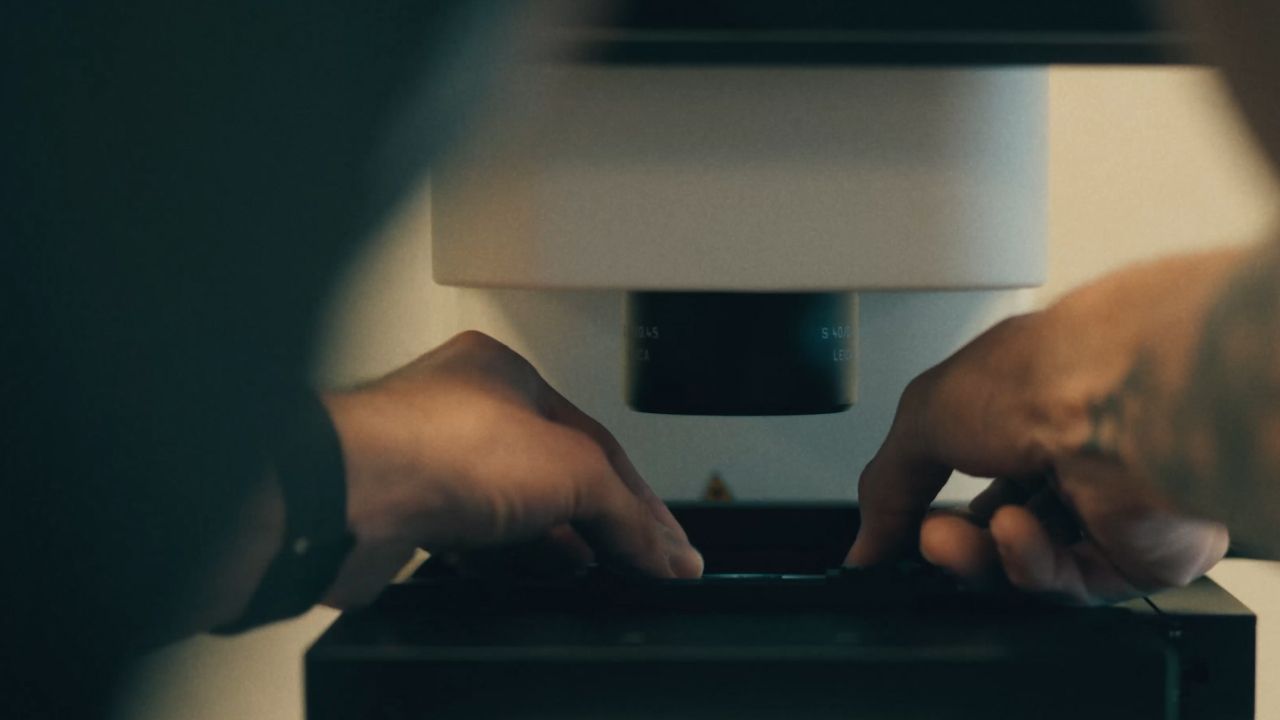 Photo: Anthropic
Anthropic announced on August 27, 2026 that it's opening a research preview of the Model Hardware Standard, or MHS — a shared specification that lets AI agents like Claude safely operate physical lab and manufacturing equipment. The pitch is straightforward: most scientific instruments and industrial devices don't share a common software interface, so wiring an AI agent up to a liquid handler, a robotic arm, or a plate reader has historically meant weeks or months of bespoke, one-off integration work. MHS is Anthropic's attempt to turn that into a standardized, hours-or-minutes job.
How it works
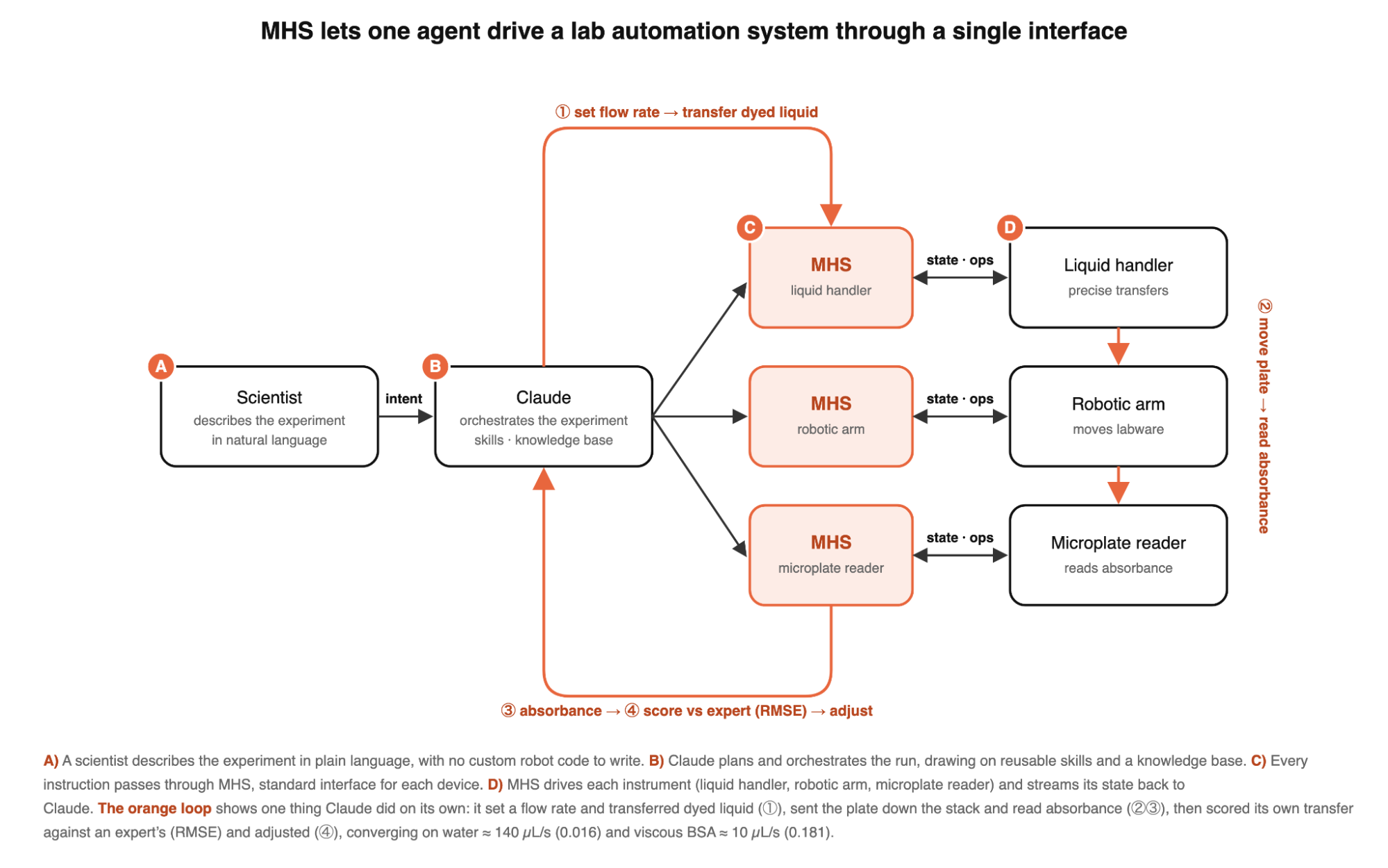
MHS provides a standardized driver layer that translates between an operating system and a piece of hardware using simple 'read' and 'write' primitives, documented with natural-language metadata describing each device's characteristics, safety limits, and operational parameters. It's designed to be model-agnostic — any agent harness can reach it through the Model Context Protocol — and hardware-flexible, working with any device that exposes a programmable interface, whether that's through MCP itself, a command-line interface, or a code-level API.
Anthropic is explicit about the limits here: 'Claude learns about the physical world through text and images, meaning its spatial and physical reasoning have limitations that still require expert oversight,' the company wrote, positioning MHS as a tool that still needs a human in the loop rather than a fully autonomous lab technician.
Early results from research partners
Anthropic is launching MHS with a first group of research organizations and manufacturers, including Genentech, the University of Washington's Baker and Pinglay Labs, Carnegie Mellon University, HHMI's Janelia Research Campus, QuEra Computing, and Tetsuwan Scientific, alongside hardware and software partners like Amazon Web Services, Universal Robots, Doosan Robotics, Tecan, QIAGEN, and Hugging Face's LeRobot project.
The reported early results are striking. At QuEra Computing, an agent using MHS improved laser recovery success from 58% to 99.3% and cut recovery time from 150 seconds to roughly 6 seconds by autonomously tuning PID parameters. At Carnegie Mellon, dose-response experiments ran about three times faster, with the agent re-running trials on its own after spotting poor curve quality. HHMI Janelia used MHS to unify seven separate vendor programs into a single interface for real-time microscopy monitoring, and Genentech had Claude autonomously optimize flow rates across a liquid handler, robotic arm, and plate reader to run a protein assay with minimal manual intervention.
What comes next
For now, MHS access is limited to this initial cohort of labs and manufacturers, with interested organizations able to apply through modelhardwarestandard.com. Anthropic says it plans an open-source release once it has completed further safety evaluations and developed clearer best practices for physical-world agent deployment — a notably more cautious rollout than the company's typical software-only feature launches, reflecting the higher stakes of letting an AI model directly control physical machinery.
If MHS holds up outside these initial partner labs, it could matter more for Anthropic's business than any single model release: a standard interface for AI-operated hardware is the kind of infrastructure bet that, if it sticks, becomes very hard for a competitor to dislodge later.
Sources
Related Stories
 Photo: Novita AI
Novita AI Review: One API for 200+ Models, GPUs, and Agent Sandboxes
Novita AI positions itself as an AI-native cloud for builders and agents, combining 200+ model APIs, GPU instances, and sandboxed agent runtimes under one account. Here's what stands out, and where the trade-offs are.
 Photo: Samsung Newsroom
Samsung Expands the Galaxy Book6 Lineup With a More Affordable 14-inch Laptop
Samsung's new Galaxy Book6 brings Intel Core Series 3 chips, a 25-hour battery, and Galaxy AI features to a $799.99 starting price, shipping October 5.
 Photo: Apple
Apple's 'Surprise and Shine' Event: What to Expect on September 9
Apple has confirmed a September 9, 2026 event, with reports pointing to the iPhone 18 Pro line, a foldable iPhone Ultra, Apple Watch Series 12, and AirPods 5.